
Though largely self explanatory, we define “brand equity” as the level of value a brand contributes to a product or service, shaped by consumer perceptions, experiences, and loyalty. It also represents a brand’s commercial value from the consumer’s perspective and is developed through elements such as brand resonance, trust, familiarity, awareness, perceived quality, and the associations people form with it.
Strong brand equity enables a company to command higher prices, increase its market share, and maintain stronger customer loyalty than its competitors. Poor brand equity can cause irreparable damage, leading consumers to actively contribute to the negative perception of the brand. In the context of sports fandom, this can ultimately lead to consumer apathy, which is widely considered a brand’s death sentence.
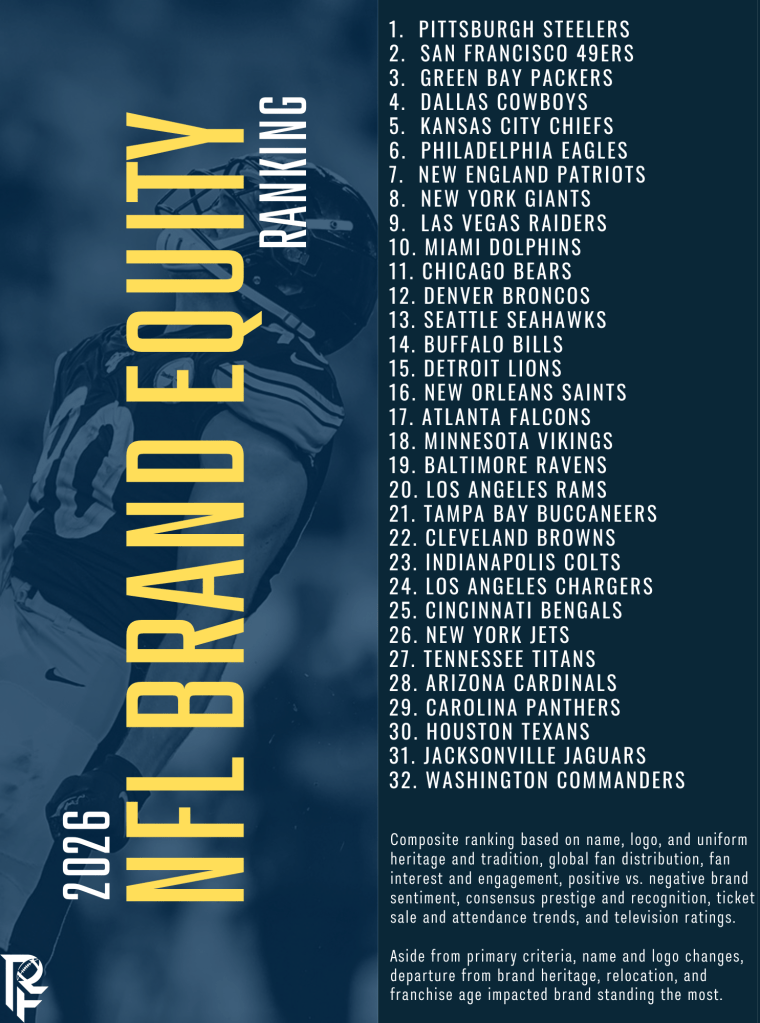
Based on publicly available data, fan sentiment, and analyst opinion, the first annual NFL Brand Equity Ranking is our featured product.
Though we weighed data gathered from fan sentiment and consumer behavior most heavily, we also collated current and historical data from ESPN, Statista, Sports Business Journal, Pro Football Reference, X, Facebook, Instagram, Forbes, CNBC, Sportico, FinanceBuzz, Brand Finance, the NFL, and more, and reached out to several reporters, writers, and pundits for additional input. Some responded to us, some did not.
General observations
The raw volume of fans a brand had did not correlate to the amount of equity it holds, given the impacts of brand health, brand perception, and other stated criteria.
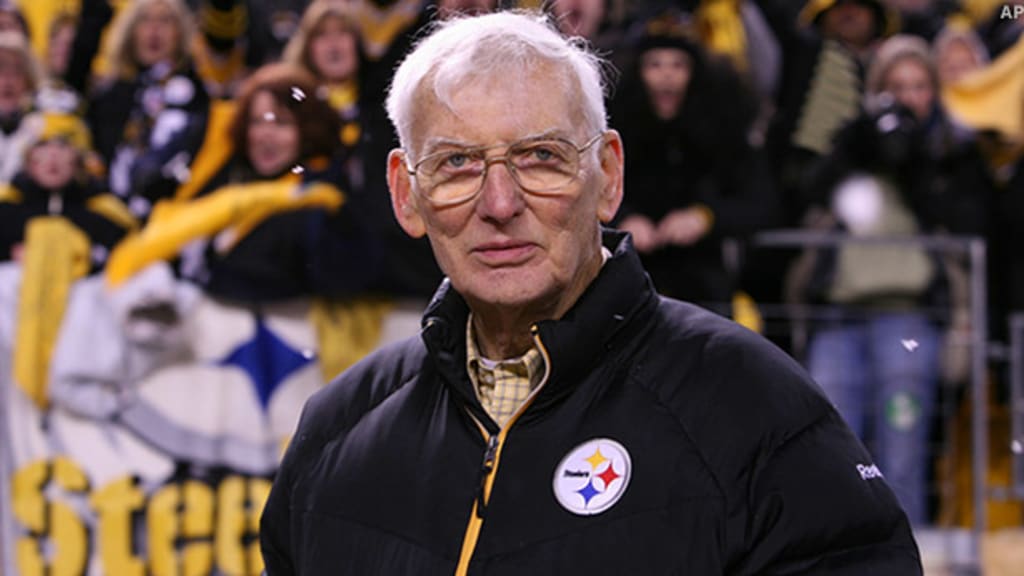
The Pittsburgh Steelers are what happens when you combine deep heritage, a national stronghold of fans (not just the ones in your local market) with an intense connection to the brand, ownership that has garnered multi-generational respect, and over two decades without a losing season.
Some of these rare superlatives can also be said of the San Francisco 49ers and Green Bay Packers. The most obvious caveat being that the Packers do not technically have an owner, which has generally worked in the brand’s favor.
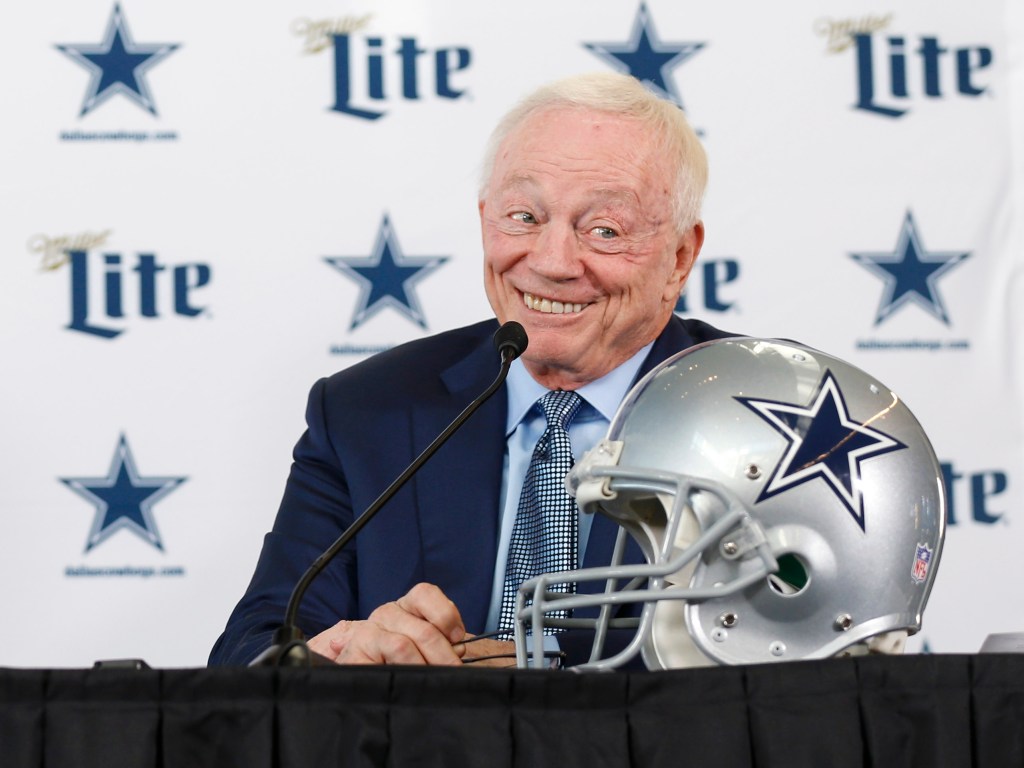
You probably don’t need us to tell you the Dallas Cowboys have the largest global NFL fan base. It’s also, from everything we gather, the most hated NFL team and supporter base in the world. While that isn’t a blow to franchise value, given apathy has a more negative impact on a franchise’s finances than disdain does, it will affect brand equity.
Many view the team — or at least its football operations — as dysfunctional, with some believing that owner Jerry Jones is stubborn and meddlesome, preventing the Cowboys brand from enjoying the practically pristine perception of those ranked ahead of it.
The Baltimore Ravens achieving a ranking in the teens is remarkable for an NFL brand less than three decades old. It’s also a lesson in what a successful pro football brand’s ceiling is even 30 years into its existence, given competition that is rich in age and heritage. For context, the next youngest brand, the Tennessee Titans, ranks 27th.
Based on our research, the Raiders would have likely slotted higher were the franchise still based in Oakland, but the brand has largely withstood its 550-mile relocation to Las Vegas thanks to a sizable national following that has no ties to Oakland to begin with.
Despite on-field success and a return to Los Angeles in 2016, disappointing home support and multiple relocations continue to hinder the Rams‘ standing vis-a-vis its brand potential. Residual impact from the team’s controversial departure from St. Louis was minimal, though measurable.
As any NFL fan can attest to, whether while roaming the aisles of their local grocer or stopping for gas, it’s not unheard of to spot a random stranger sporting Detroit Lions paraphernalia. From our research, the Lions logo enjoys the most public national exposure of any that belongs to an NFL team that has never been to a Super Bowl. Buoyed somewhat by recent post-season appearances, Detroit diaspora — and not just locals — continue to hold a deep attachment to their football team, and it’s no accident that it’s for a brand approaching 92 years of age.
The Washington Commanders suffer from significantly worse perception than any brand in the league, beset by unrelenting popular rejection since its inception in 2022. Our findings are corroborated by Brand Finance’s Annual report on the most valuable and strongest NFL brands, which ranks the value of the Commanders brand amongst the worst in the league.
Countless obstacles contribute to the ongoing and insurmountable challenges plaguing a franchise that used to have one of the most beloved brands in all of sports. Those include:
1) General antipathy toward the name and logo,
2) the brand’s association to former owner Dan Snyder,
3) the brand’s departure from [and irrelevance to] franchise heritage,
4) the name and logo being a permanent reminder of the 2020-22 rebrand process that saw fan votes and suggestions go ignored,
5) unanswered questions over why so much of the former Redskins brand was discarded,
6) and distaste surrounding the contextual connotations and insensitivity of rebranding to “Commanders” of all names.
How select franchises can improve brand value and equity
The Texans were gaining brand momentum late in 2025, even outside of the Houston metro area, and are a candidate for ascension by this time next year, bearing in mind that any significant year-over-year movement is difficult. This momentum is spearheaded by Houston natives around the country growing more willing to associate with the brand.
Losing records in 10 of the last 12 seasons have impacted the New York Giants brand about as much as it conceivably can short of relocation. The eighth-to-tenth range seems to be its floor, but strong heritage and a large latent base makes them a candidate for quick ascension closer to their ceiling in fourth-to-sixth. However, it may require a year or two of post-season football.
Luckiest are brands like the Giants, that have so much accrued equity they remain top 10 no matter how much they lose, and only need a few winning seasons to re-encroach on the top five.
Seventeenth isn’t terrible for a Falcons brand that has never won a Lombardi Trophy. But with a ceiling just outside the top 10, every detail counts. Atlanta would do well to listen to its fan base and make its 1980s throwback uniforms a more permanent staple. Normally, a uniform change would barely register a blip on the brand equity radar, but so unanimous is the push from prideful Hotlanta faithful that this move alone would be worth multiple post-season berths.
One team that has tried to do just about everything outside of winning to bolster brand equity is the Browns. Pulling out throwback uniforms, various alternates, historical logos, the whole nine yards. Browns ownership has really leaned into heritage. If they can finally get their long-coveted franchise quarterback (we know, gargantuan “if” based on the team’s past), and thus build a consistent winner, keep an eye on Cleveland. Every other ingredient is in place.
The Tennessee Titans have hinted at shelving their Houston Oilers throwback fit. Perhaps they’ve adjudged former Oilers fans to have mostly moved on, and that it’s no longer a benefit to the Titans brand. That may be the case for local Titans devotees, but the Oilers logo and uniforms are among the only elements giving the Titans brand national appeal, however occasionally they’re donned.
The Titans are said to be working on a primary uniform change that will resemble the old Oilers uniform and color scheme. If the rumors are true, that new uniform will need to be a hit, and together with a new stadium set to open in 2027, brand equity should be boosted a couple of notches.
The odd firing of former head coach Robert Saleh stunted what appeared to be a fledgling takeoff for the seemingly cursed New York Jets. You almost have to be intentional about equity this poor if you’re a 63-year-old brand in this market.
It’s almost inconceivable that Jets brand equity could get any worse. Given its age and market size, we think this is its floor. Front office and head coach stability alone would do wonders. At least owner Woody Johnson has been candid with the disappointment of his stewardship, recently telling The Athletic’s Dianna Russini that he’s “obviously not a good owner in terms of winning.”
When it comes to underachieving relative to market potential, only the brand in Washington can give the Jets a run for its money, but at least a quick solution is available to Josh Harris and his ownership group, unlike Johnson’s.
No brand on this list has a higher ranking-to-ceiling differential than the Washington Commanders, but substantial improvement to equity appears impossible with the current name and logo. The absence of relative growth coming off of a conference championship appearance is confirmation.
Their 2025 “Super Bowl Era” alternate uniform, said to become permanent in 2026, is a “fauxback” meant to mimic the Redskins era. It contains a critical omission, however. It forgoes legacy Redskins logos for the most hated one in the league, and thus did not make a dent in brand perception. It was barely even celebrated by the shell of the franchise’s former fan base, and did not inspire a reversal of the scorned majority’s mass exodus.
Of every team on this list, Washington has the easiest path to ascension. With almost any replacement to the current name and logo, they could go 0-17 for the next 5 years and still never have brand equity as low as it is now.
Clunkiness of the league’s longest city-name-and-moniker-combination aside, the aforementioned baggage the Commanders brand carries, and the disdain for it amongst fans, is as current and proactive today as it was in 2022. So deep is the vitriol for the Snyder-turned-Harris brand name often described as “soulless” and “corporate,” fans often refer to the team as the “Commies,” historically shorthand for “communist.” And with that color scheme, who can blame them? This isn’t your uncle’s burgundy and gold.
Managing partner Josh Harris would do well to act fast, as goodwill from his purchase of the team has all but eroded, replaced with a growing perception that he and his ownership group are indifferent toward — and too cheap to fix — what countless polls and surveys show is by far the most glaring issue to the fan base.
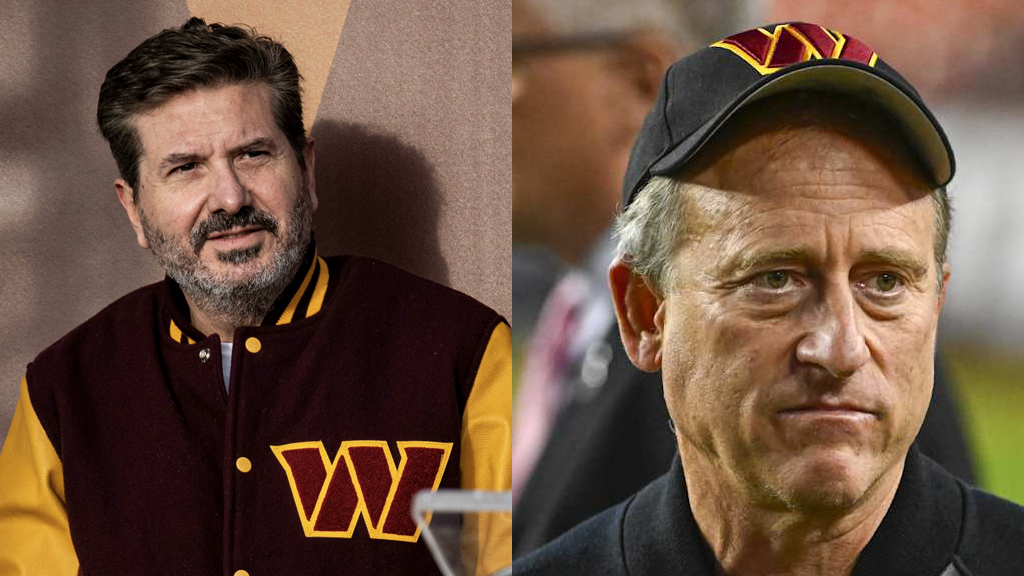
Based on our analysis of growing mentions in social media posts that include both names, Harris has now become attached to the hated brand in Washington as much as Snyder is, a once-unthinkable turn of events.
General trust in Harris also sharply declined in 2025, according to our findings. The Philadelphia 76ers, New Jersey Devils, and Crystal Palace FC owner suggested when he bought the Commanders that he would handle the brand the way fans want him to. Fast forward to 2025, and he has instead defended his inaction by claiming employees in his business and football operations, none of which have the lifelong attachment to the franchise that fans do, “are embracing” the name, and that “we tag people with these yellow tags and say ‘that’s a commander, and that’s a commander.’” In other words, fan sentiment is being ignored by Josh Harris, Mitch Rales, Mark Ein, Magic Johnson, and the rest of that ownership group the same way it was by Dan Snyder during the team’s infamous rebrand process.
While the data suggests a desire among fans to restore the Redskins, once the most valuable NFL franchise,it also crucially reveals that team owners don’t even have to do that to rescue matters.
In fact, the vast majority seem to be willing to accept any name it can reconcile with the team’s heritage and that it can pair with legacy logos, like the iconic Native American warrior profile created by former Blackfeet Chief and President of the National Congress of American Indians, Walter “Blackie” Wetzel.
Even NFL sponsors are on board with Washington’s classic imagery, as revealed from meetings between the league’s corporate partners and government staffers.
“We shared history of [the] Blackfeet logo with 10-12 major NFL sponsors. NONE expressed concern to us with [the] concept of featuring the logo on [uniforms] or NFL-licensed [merchandise],” Darin Thacker, Chief of Staff for Montana Rep. Steve Daines, said via his X account.
Newspaper and media polls we analyzed showed Warriors, Redwolves, Braves, and Hogs all generated considerable excitement, and still do for fans who have not yet lost all hope of rescuing the team they grew up loving. The moment it’s born, any new brand in Washington would instantly hold greater equity than the current one. Any name and logo that is even a remote callback to the franchise’s illustrious history would jolt this sleeping giant awake.
It’s a no-brainer move, the absence of which can only be explained by a lack of reverence for fan sentiment and an unwillingness to foot the bill. Oxford scholar Robert Burton said it best in his 1621 work, The Art of Melancholy… Josh Harris’s decision to preserve the brand founded by reviled former owner Dan Snyder is “penny wise, pound foolish.”
Follow @RankingFootball on X to connect.


